Обзор «Лактоферрин и возможность его применение при нанесении на кожу»
Полифункциональность лактоферрина (ЛФ), спектр его биохимических и физиологических функций, представлены на рисунке 1.

Наиболее интересными активностями ЛФ в практическом применении при нанесении на кожу являются: противовоспалительная, регенеративная, антиоксидантная, антибактериальная/противовирусная, апоптоз и ангиогениновая регуляции.
Важно отметить, что лактоферрин проявляет много активностей и утверждение «один белок одна функция» к нему не применимо.
В нормальном состоянии ЛФ постоянно присутствует на коже млекопитающих в определенных концентрациях. При травме, воспалении кожи орошение поврежденного участка экзогенным лактоферрином усиливает защитное действие своего, эндогенного лактоферрина.
Чтобы подробнее рассмотреть механизм действия ЛФ, необходимо, прежде всего, в деталях разобрать строение кожи. Кожа рассматривается как функциональный «экзоорган» со своим сложным строением и физиологическими функциями и состоит из трех слоев: эпидермиса, собственно кожи и подкожной жировой клетчатки. Каждый из них, в свою очередь, состоит из нескольких слоев (две схематические иллюстрации ниже).
Чтобы подробнее рассмотреть механизм действия ЛФ, необходимо, прежде всего, в деталях разобрать строение кожи. Кожа рассматривается как функциональный «экзоорган» со своим сложным строением и физиологическими функциями и состоит из трех слоев: эпидермиса, собственно кожи и подкожной жировой клетчатки. Каждый из них, в свою очередь, состоит из нескольких слоев (две схематические иллюстрации ниже).
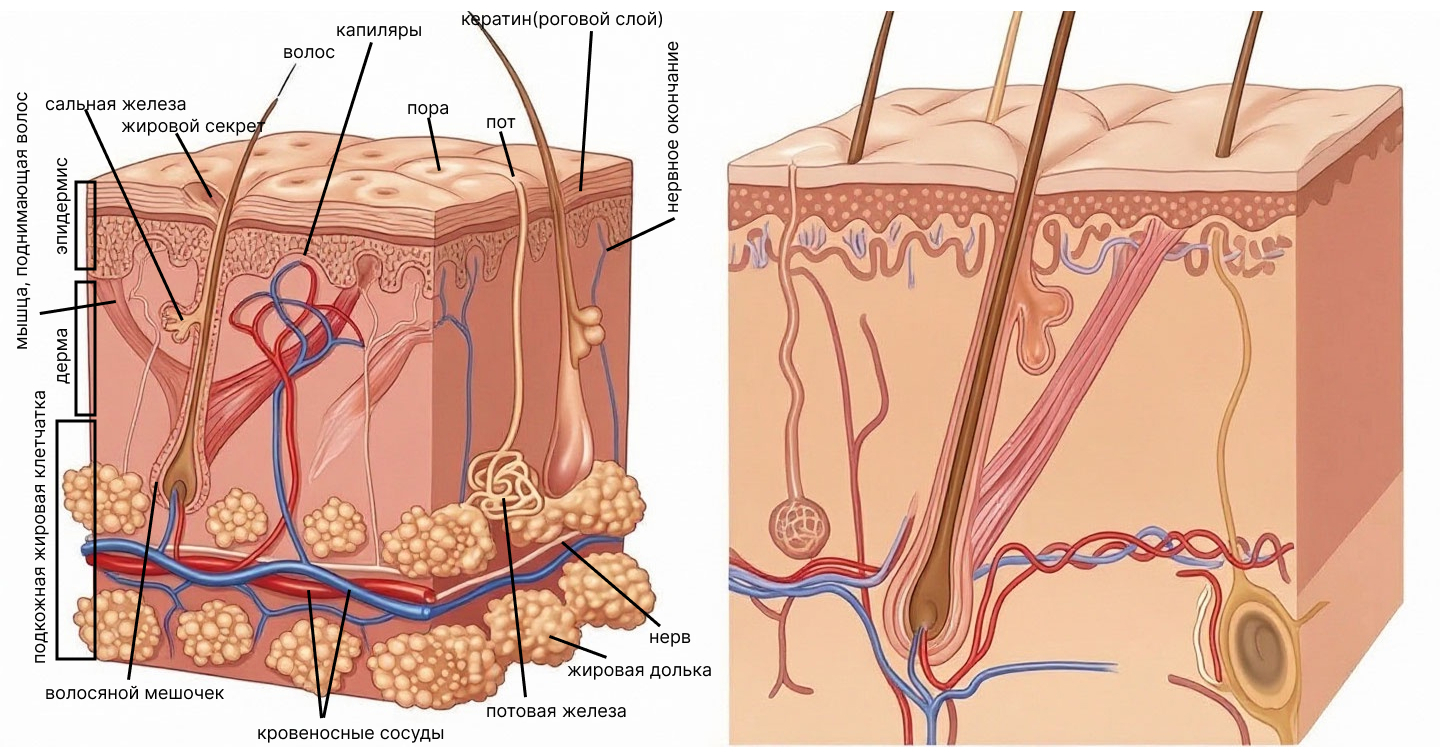
Для упрощения ситуации, мы будем рассматривать только 3 основных слоя кожи, а также потовые железы, корни волос, сальные железы и нервные волокна.
Эпидермис - Толщина его колеблется от 0,03 на лице до 1,5 мм и более (ладони, подошвы).
Дерма - 2 мм слой.
Гиподерма - подкожная жировая клетчатка, почти отсутствует в коже вокруг глаз.
Эпидермис - Толщина его колеблется от 0,03 на лице до 1,5 мм и более (ладони, подошвы).
Дерма - 2 мм слой.
Гиподерма - подкожная жировая клетчатка, почти отсутствует в коже вокруг глаз.
Эпидермис и ЛФ
Эпидермис – самый верхний слой кожи. В нем различают поверхностный роговой слой, представленный плотно прилегающими друг к другу мертвыми и ороговевшими клетками, которые постоянно отделяются и заменяются новыми. Этот слой выполняет первичную защитную функцию. Именно он встает на пути негативного влияния на организм различных факторов. Особенности строения эпидермиса обеспечивают его эластичность, упругость и прочность. Полное же обновление клеток эпидермиса происходит в течение 26-28 дней. Ни у одного органа клетки не размножаются и не растут с такой скоростью, как у кожи.
Эпидермальные клетки содержат рецептор для связывания ЛФ, что позволяет этому белку влиять на пролиферацию (созревание) и рост эпителия, синтезу компонентов межклеточного матрикса – коллагена и гиалуроной кислоты, что приводит к быстрому восстановлению эпидермиса при малейших повреждениях.
ЛФ активирует синтез IL18, который является ключевым компонентом при заживлении ран и модулятором синтеза колонийстимулирующего фактора GMCSF, участвующего в ранних процессах регенерации кожи. Более того, ЛФ приводит к более быстрому замещению пораженных клеток дермы здоровыми, запуская механизм апоптоза пораженных клеток.
Защитная функция эпидермиса определяется и наличием на наружном слое кислотножирового слоя, который эффективно защищает организм от микроорганизмов. Именно при кислом рН (4,5-5,0), ЛФ наиболее активен по отношению к патогенам.
Отметим, что грибковые патогены менее чувствительны к низкой кислотности по сравнению с микроорганизмами – в этом случае противогрибковая активность ЛФ дополнительно усиливает защитные свойства кожи.
Нижний «зародышевый» слой эпидермиса является источником всех клеток, из которых состоит наружный слой кожи. Помимо уже описанных клеток различают иммунные клетки (клетки Лангерганса), которые также имеют рецепторы к ЛФ. При взаимодействии ЛФ с клетками Лангерганса стимулируется или ингибируется синтез этими клетками специальных молекул-эффекторов (интерлейкинов, факторов роста и проч.). В свою очередь, эти эффекторы являются важными регуляторами воспалительных процессов и защитными факторами, которые обеспечивают сигнальную коммуникацию между иммунными клетками. Как пример, можно рассмотреть подавление лактоферрином синтеза провоспалительных факторов (TNF-альфа, интерлейкина IL-1альфа) кератиноцитами, что в свою очередь приводит к подавлению аллергических реакций кожи в ответ на антигены окружающей среды.
Широко обсуждаются механизмы поражения кожи под действием свободных радикалов. Во всяком случае, использование антиоксидантных агентов в косметологии приводит к частичному восстановлению кожи. ЛФ является мощным природным антиоксидантом. Из 4-х рекций образования свободных радикалов этот белок ингибирует 2 (см. ниже):
Защитная функция эпидермиса определяется и наличием на наружном слое кислотножирового слоя, который эффективно защищает организм от микроорганизмов. Именно при кислом рН (4,5-5,0), ЛФ наиболее активен по отношению к патогенам.
Отметим, что грибковые патогены менее чувствительны к низкой кислотности по сравнению с микроорганизмами – в этом случае противогрибковая активность ЛФ дополнительно усиливает защитные свойства кожи.
Нижний «зародышевый» слой эпидермиса является источником всех клеток, из которых состоит наружный слой кожи. Помимо уже описанных клеток различают иммунные клетки (клетки Лангерганса), которые также имеют рецепторы к ЛФ. При взаимодействии ЛФ с клетками Лангерганса стимулируется или ингибируется синтез этими клетками специальных молекул-эффекторов (интерлейкинов, факторов роста и проч.). В свою очередь, эти эффекторы являются важными регуляторами воспалительных процессов и защитными факторами, которые обеспечивают сигнальную коммуникацию между иммунными клетками. Как пример, можно рассмотреть подавление лактоферрином синтеза провоспалительных факторов (TNF-альфа, интерлейкина IL-1альфа) кератиноцитами, что в свою очередь приводит к подавлению аллергических реакций кожи в ответ на антигены окружающей среды.
Широко обсуждаются механизмы поражения кожи под действием свободных радикалов. Во всяком случае, использование антиоксидантных агентов в косметологии приводит к частичному восстановлению кожи. ЛФ является мощным природным антиоксидантом. Из 4-х рекций образования свободных радикалов этот белок ингибирует 2 (см. ниже):
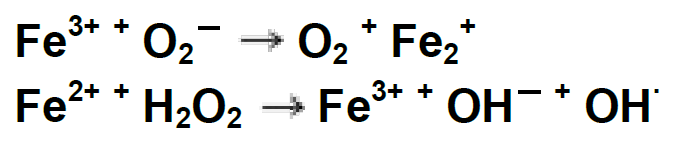
Таким образом, использование ЛФ, как антиоксиданта вполне оправдано.
Помимо этого, пораженный участок кожи это место через которое проникают патогены, наличие антибактериальной/противовирусной активности у Лф позволяет защитить рану от инфекции.
Дерма и ЛФ
Дерма (собственно кожа) – плотная соединительная ткань, содержащая капилляры и лимфатические сосуды, мышечные и нервные волокна, сенсорные клетки, потовые железы, волосяные фолликулы. Самым большим компонентом дермы является коллаген, из которого волокна дермы состоят на 97,5%. в то время, как эластические волокна коллагена не содержат. Скорость синтеза дермального коллагена определяется клетками фибробластов. Поверхность этих клеток содержит эстрогенные рецепторы, которые связываются и с ЛФ.
Результатом такого взаимодействия является многократное усиление синтеза коллагена фибробластами, соответственно:
1) бесшрамовому заживлению пораженных участков кожи
2) восстановление морфологии дермальных коллагеновых волокон
Интересно, что в норме коллаген-содержащие волокна мало изменяются, а вот эластичные волокна подвергаются дегенерации, что приводит к атрофии дермы. В последние годы в экспериментах in vitro было установленно, что фибробласты под действием ЛФ усиливают синтез белка эластина, основного компонента неколлагеновых волокон, что делает ЛФ еще более привлекательным в применении для заживления ран.
Снабжение кожи кровью происходит через сеть капилляров, которые пронизывают дерму. Эффект ЛФ на кровеностные микрососуды давно известен – он является гуморальным факторов, вызывающим рост и митотическое деление клеток стенок сосудов (проангиогениновая активность), что приводит к развитию капиллярной системы, а как следствие, усилению питания кожи.
Нервные окончания, которые пронизывают дерму, определяют: осязание, ощущение боли, давление, тепло, холод и проч. ЛФ является «чистильщиком» нервных волокон, связывая ионы металлов, которые накапливаются в миелине с возрастом и при травме, что приводит к дегенеративным изменения нервной ткани.
Результатом такого взаимодействия является многократное усиление синтеза коллагена фибробластами, соответственно:
1) бесшрамовому заживлению пораженных участков кожи
2) восстановление морфологии дермальных коллагеновых волокон
Интересно, что в норме коллаген-содержащие волокна мало изменяются, а вот эластичные волокна подвергаются дегенерации, что приводит к атрофии дермы. В последние годы в экспериментах in vitro было установленно, что фибробласты под действием ЛФ усиливают синтез белка эластина, основного компонента неколлагеновых волокон, что делает ЛФ еще более привлекательным в применении для заживления ран.
Снабжение кожи кровью происходит через сеть капилляров, которые пронизывают дерму. Эффект ЛФ на кровеностные микрососуды давно известен – он является гуморальным факторов, вызывающим рост и митотическое деление клеток стенок сосудов (проангиогениновая активность), что приводит к развитию капиллярной системы, а как следствие, усилению питания кожи.
Нервные окончания, которые пронизывают дерму, определяют: осязание, ощущение боли, давление, тепло, холод и проч. ЛФ является «чистильщиком» нервных волокон, связывая ионы металлов, которые накапливаются в миелине с возрастом и при травме, что приводит к дегенеративным изменения нервной ткани.
Гиподерма и Лактоферрин
Сетчатый слой дермы не имеет четких границ и плавно переходит в самый грубый слой кожи — гиподерму (подкожную жировую клетчатку), которая представляет собой грубую широкопетлистую сеть из толстых пучков коллагеновых волокон. Петли этой сети заполнены жировыми дольками. Подкожная клетчатка образует упругую теплоизолирующую прокладку и благодаря своей рыхлой структуре обусловливает прочное и подвижное прикрепление кожи к лежащим под ней тканям. Все активности ЛФ, которые характерны для дермального слоя, могут быть «экстраполированы» на гиподерму (синтез коллагена, восстановление структуры, регенерация, апоптоз и тд).
В заключении можно сказать, что крайне тяжело описать все механизмы действия ЛФ на ткани кожи, так как они включают в себя и биохимические и гуморальные активности.
В ряде случаев необходимо говорить о целых метаболических каскадах реакций, особенно в случае взаимодействия ЛФ с клеточными рецепторами (запускаются реакции фосфорилирования/дефосфорилирования, опосредованное или прямое влияние на ядро клетки, активация или ингибирование определенных групп генов и тд).
Из этого краткого обзора надеемся, что специалисты, которые непосредственно связаны с клинической практикой, смогут сделать полезные заключения.
В заключении можно сказать, что крайне тяжело описать все механизмы действия ЛФ на ткани кожи, так как они включают в себя и биохимические и гуморальные активности.
В ряде случаев необходимо говорить о целых метаболических каскадах реакций, особенно в случае взаимодействия ЛФ с клеточными рецепторами (запускаются реакции фосфорилирования/дефосфорилирования, опосредованное или прямое влияние на ядро клетки, активация или ингибирование определенных групп генов и тд).
Из этого краткого обзора надеемся, что специалисты, которые непосредственно связаны с клинической практикой, смогут сделать полезные заключения.
Список литературы
References
Ames et al., 1974. G.F. Ames, E.N. Spudich and H. Nikaido, Protein composition of the outer membrane of Salmonella
typhimurium: effect of lipopolysaccharide mutations. J. Bacteriol. 117 (1974), pp. 406–416.
Anderson et al., 1987. B.F. Anderson, H.M. Baker, E.J. Dodson, G.E. Norris, S.V. Rumball, J.M. Waters and E.N.
Baker, Structure of human lactoferrin at 3.2-Å resolution. Proc. Natl. Acad. Sci. U.S.A. 84 (1987), pp. 1769–1773.
Anderson et al., 1989. B.F. Anderson, H.M. Baker, G.E. Norris, D.W. Rice and E.N. Baker, Structure of human
lactoferrin: crystallographic structure analysis and refinement at 2.8 Å resolution. J. Mol. Biol. 209 (1989), pp. 711–734.
Appelmelk et al., 1994. B.J. Appelmelk, Y.-Q. An, M. Geerts, B.G. Thijs, H.A. de Boer, D.M. MacLaren, J. de Graaff and
J.H. Nuijens, Lactoferrin is a lipid A-binding protein. Infect. Immun. 62 (1994), pp. 2628–2632.
Arnold et al., 1977. R.R. Arnold, R.M. Cole and J.R. McGhee, A bactericidal effect for human lactoferrin. Science
(Washington, DC) 197 (1977), pp. 263–265.
Arnold et al., 1980. R.R. Arnold, M. Brewer and J.J. Gauthier, Bactericidal activity of human lactoferrin: sensitivity of a
variety of microorganisms. Infect. Immun. 28 (1980), pp. 893–898.
Arnold et al., 1981. R.R. Arnold, J.E. Russell, W.J. Champion and J.J. Gautheir, Bactericidal activity of human
lactoferrin: influence of physical conditions and metabolic state of the target microorganism. Infect. Immun. 32 (1981),
pp. 655–660.
Baker et al., 2002. E.N. Baker, H.M. Baker and R.D. Kidd, Lactoferrin and transferrin: functional variations on a
common structural framework. Biochem. Cell Biol. 80 (2002), pp. 27–34.
Bellamy et al., 1992a. W. Bellamy, M. Takase, K. Yamauchi, H. Wakabayashi, K. Kawase and M. Tomita, Identification
of the bactericidal domain of lactoferrin. Biochim. Biophys. Acta 1121 (1992), pp. 130–136.
Bellamy et al., 1992b. W. Bellamy, M. Takase, H. Wakabayashi, K. Kawase and M. Tomita, Antibacterial spectrum of
lactoferricin B, a potent bactericidal peptide derived from the N-terminal region of bovine lactoferrin. J. Appl. Bacteriol.
73 (1992), pp. 472–479.
Bellamy et al., 1993. W.R. Bellamy, H. Wakabayashi, M. Takase, S. Shimamura and M. Tomita, Role of cell-binding in
the antibacterial mechanism of lactoferricin B. J. Appl. Microbiol. 75 (1993), pp. 478–484.
Bevins, 1994. C. Bevins, Antimicrobial peptides as agents of mucosal immunity. Ciba Found. Symp. 186 (1994), pp.
250–269.
Blondelle et al., 1995. S.E. Blondelle, E. Takahashi, K.T. Dinh and R.A. Houghten, The antimicrobial activity of
hexapeptides derived from synthetic combinatorial libraries. J. Appl. Bacteriol. 78 (1995), pp. 39–46.
Boman, 1995. H.G. Boman, Peptide antibiotics and their role in innate immmunity. Ann. Rev. Immun. 13 (1995), pp. 61–
92.
Bortner et al., 1986. C.A. Bortner, R.D. Miller and R.R. Arnold, Bactericidal effect of lactoferrin on Legionella
pneumophila. Infect. Immun. 51 (1986), pp. 373–377.
Bortner et al., 1989. C.A. Bortner, R.R. Arnold and R.D. Miller, Bactericidal effect of lactoferrin on Legionella
pneumophila: effect of the physiological state of the organism. Can. J. Microbiol. 35 (1989), pp. 1048–1051.
Brock, 2002. J.H. Brock, The physiology of lactoferrin. Biochem. Cell Biol. 80 (2002), pp. 1–6. Chapple et al., 1998. D.S.
Chapple, D.J. Mason, C.L. Joannou, E.W. Odell, V. Gant and R.W. Evans, Structure-function relationship of
antibacterial synthetic peptides homologous to a helical surface region on human lactoferrin against Escherichia coli
serotype O111. Infect. Immun. 66 (1998), pp. 2434–2440.
Cirioni et al., 2000. O. Cirioni, A. Giacometti, F. Barchiesi and G. Scalise, Inhibition of growth of Pneumocystis carinii by
lactoferrins alone and in combination with pyrimethamine, clarithromycin and minocycline. J. Antimicrob. Chemother. 46
(2000), pp. 577–582.
Crouch et al., 1992. S.P. Crouch, K.J. Slater and J. Fletcher, Regulation of cytokine release from mononuclear cells by
the iron-binding protein lactoferrin. Blood 80 (1992), pp. 235–240.
Elass-Rochard et al., 1995. E. Elass-Rochard, A. Roseanu, D. Legrand, M. Trif, V. Salmon, C. Motas, J. Montreuil and
G. Spik, Lactoferrin-lipopolysaccharide interaction: involvement of the 28–34 loop region of human lactoferrin in the
high-affinity binding to Escherichia coli 055B5 lipopolysaccharide. Biochem. J. 312 (1995), pp. 839–845.
Ellison and Giehl, 1991. R.T. Ellison, III and T.J. Giehl, Killing of Gram negative bacteria by lactoferin and lysozyme. J.
Clin. Invest. 88 (1991), pp. 1080–1091.
Ellison et al., 1988. R.T. Ellison, III, T.J. Giehl and F.M. LaForce, Damage of the outer membrane of enteric Gramnegative bacteria by lactoferrin and transferrin. Infect. Immun. 56 (1988), pp. 2774–2781.
Ellison et al., 1990. R.T. Ellison, III, F.M. LaForce, T.J. Giehl, D.S. Boose and B.E. Dunn, Lactoferrin and transferrin
damage of the Gram-negative outer membrane is modulated by Ca2+ and Mg2+. J. Gen. Microbiol. 136 (1990), pp.
1437–1446.
Esposito and Obljeski, 1976. J.J. Esposito and J.F. Obljeski, Enterovirus type 70 virion and intracellular proteins. J.
Virol. 18. (1976), pp. 1160–1162.
Evans and Oakhill, 2002. R.W. Evans and J.S. Oakhill, Transferrin-mediated iron acquisition by pathogenic Neisseria.
Biochem. Soc. Trans. 30 (2002), pp. 705–707.
Gazit et al., 1994. E. Gazit, W.J. Lee, P.T. Brey and Y. Shai, Mode of action of the antimicrobial cecropin B2: a
spectrofluorometric study. Biochemistry 33 (1994), pp. 10681–10692.
Gonzales et al., 1990. G.C. Gonzales, D.L. Caamo and A.B. Schryvers, Identification and characterisation of a porcinespecific transferring receptor in Actinobacillus pleuropneumoniae. Mol. Microbiol. 4 (1990), pp. 1173–1179.
Griffiths and Williams, 1999. Griffiths, E., Williams, P., 1999. The iron-uptake systems of pathogenic bacteria, fungi and
protozoa. In: Bullen, J.J., Griffiths, E. (Eds.), Iron and Infection: Molecular, Physiological and Clinical Aspects. second
ed. Wiley, Chichester, pp. 87–212.
Grossmann et al., 1992. J.G. Grossmann, M. Neu, E. Pantos, F.J. Schwab, R.W. Evans, E. Townes-Andrews, H. Appel,
W.G. Thies and S.S. Hasnain, X-ray solution scattering reveals conformational changes upon iron uptake in lactoferrin,
serum, and ovo-transferrins. J. Mol. Biol. 225 (1992), pp. 811–819.
Groves, 1960. M.L. Groves, The isolation of a red protein from milk. J. Am. Chem. Soc. 82 (1960), pp. 3345–3350.
Hancock, 1997. R.E.W. Hancock, Peptide antibiotics. Lancet 349 (1997), pp. 418–422.
Hancock and Lehrer, 1998. R.E.W. Hancock and R. Lehrer, Cationic peptides: a new source of antibiotics. TIB. TECH.
16 (1998), pp. 82–88.
Hancock and Chapple, 1999. R.E.W. Hancock and D.S. Chapple, Antibiotic peptides. Antimicrob Agents Chemo. 43
(1999), pp. 215–220.
Hancock and Diamond, 2000. R.E.W. Hancock and G. Diamond, Cationic antimicrobial peptides: a major element in
mammalian innate immune defences against infection. Trends Microbiol. 8 (2000), pp. 402–410.
Hancock et al., 1981. R.E.W. Hancock, V.J. Raffle and T.I. Nicas, Involvement of the outer membrane in gentamicin
and streptomycin uptake and killing in Pseudomonas aeruginosa. Antimicrob. Agents Chemother. 19 (1981), pp. 777–
785.
Herrington and Sparling, 1985. D.A. Herrington and P.E. Sparling, Haemophilus influenzea can use human transferrin
as a sole source of required iron. Infect. Immun. 48 (1985), pp. 248–251. View Record in Scopus | Cited By in Scopus
(19)
Hoek et al., 1997. K.S. Hoek, J.M. Milne, P.A. Grieve, D.A. Dionysius and R. Smith, Antibacterial activity in bovine
lactoferrin-derived peptides. Antimicrob. Agents Chemother. 41 (1997), pp. 54–59. View Record in Scopus | Cited By in
Scopus (64)
Houghten et al., 1991. R.A. Houghten, C. Pinilla, S.E. Blondelle, J.R. Appel, C.T. Dooley and J.H. Cuervo, Generation
and use of synthetic peptide combinatorial libraries for basic research and drug discovery. Nature 354 (1991), pp. 85–
86.
Hovanessian and Awdeh, 1976. A.G. Hovanessian and Z.L. Awdeh, Gel isoelectric focussing of human serum
transferrin. Eur. J. Biochem. 68 (1976), pp. 333–338.
Ikeda et al., 1998. M. Ikeda, K. Sugiyama, T. Tanaka, H. Sekihara, K. Shimotohno and N. Kato, Lactoferrin markedly
inhibits hepatitis C virus infection in cultured human hepatocytes. Biochem. Biophys. Res. Commun. 245 (1998), pp.
253–549.
Johansson, 1960. B.G. Johansson, Isolation of an iron-containing red protein from human milk. Acta Chem. Scand. 14
(1960), pp. 510–512.
Kalmar and Arnold, 1988. J.R. Kalmar and R.R. Arnold, Killing of Actinobacillus actinomycetemcomitans by human
lactoferrin. Infect. Immun. 56 (1988), pp. 2552–2557.
Kang et al., 1996. J.H. Kang, M.K. Lee, K.L. Kim and K.S. Hahan, Structure-biological activity relationship of 11-residue
highly basic peptide segment of bovine lactoferrin. Int. J. Pep. Prot. Res. 48 (1996), pp. 357–363. Kirkpatrick et al.,
1971. C.H. Kirkpatrick, I. Green, R.R. Rich and A.L. Schade, Inhibition of growth of Candida albicans by ironunsaturated lactoferrin: relation to host-defense mechanisms in chronic mucocutaneous candidiasis. J. Infect. Dis. 124
(1971), pp. 539–544.
Kuipers et al., 1999. M.E. Kuipers, H.G. de Vries, M.C. Eikelboom, D.K.F. Meijer and P.J. Swart, Synergistic fungistatic
effects of lactoferrin in combination with antifungal drugs against clinical Candida isolates. Antimicrob. Agents
Chemother. 43 (1999), pp. 2635–2641.
Labischinski et al., 1985. H. Labischinski, G. Barnickel, H. Bradaczek, D. Naumann, E.T. Rietschel and P. Giesbrecht,
High state of order of isolated bacterial lipopolysaccharide and its possible contribution to the permeability barrier
properties of the outer membrane. J. Bacteriol. 162 (1985), pp. 9–20.
Laquerre et al., 1998. S. Laquerre, R. Argnani, D.B. Anderson, S. Zucchini, R. Manservigi and J.C. Glorioso, Heparan
sulphate proteoglycan binding by herpes simplex virus type I glycoproteins B and C, which differ in their contributions to
virus attachment, penetration, and cell-to-cell spread. J. Virol. 72 (1998), pp. 6119–6130.
Lassiter et al., 1987. M.O. Lassiter, A.L. Newsome, L.D. Sams and R.R. Arnold, Characterization of lactoferrin
interaction with Streptococcus mutans. J. Dental Res. 66 (1987), pp. 480–485.
Levay and Viljoen, 1995. P.F. Levay and M. Viljoen, Lactoferrin: a general review. Haematologica 80 (1995), pp. 252–
267.
Lewis et al., 1998. L.A. Lewis, K. Rohde, M. Gipson, B. Behrens, E. Gray, S.I. Toth, B.A. Roe and D.W. Dyer,
Identification and molecular analysis of IbpBA, which encodes the two-component meningococcal lactoferrin receptor.
Infect. Immun. 66 (1998), pp. 3017–3023.
Mann et al., 1994. D.M. Mann, E. Romm and M. Migliorini, Delineation of glycosaminoglycan-binding site in human
inflammatory response protein lactoferrin. J. Biol. Chem. 269 (1994), pp. 23661–23667.
Martin et al., 1995. E. Martin, T. Gantz and R. Lehrer, Defensins and other endogenous peptide antibiotics of
vertebrates. J. Leukoc. Biol. 58 (1995), pp. 128–136.
Masson and Heremans, 1971. P.L. Masson and J.F. Heremans, Lactoferrin in milk from different species. Comp.
Biochem. Physiol. 39B (1971), pp. 119–129.
Metz-Boutigue et al., 1984. M.-H. Metz-Boutigue, J. Jolles, J. Mazurier, F. Schoentgen, D. Legrand, G. Spik, J.
Montreuil and P. Jolles, Human lactotransferrin: amino acid sequence and structural comparisons with other
transferrins. Eur. J. Biochem. 145 (1984), pp. 659–676.
Mihara and Takahashi, 1997. H. Mihara and Y. Takahashi, Engineering peptides and proteins that undergo alpha-tobeta transitions. (Erratum appears in Curr. Opin. Struct. Biol. 7 (1997) 749). Curr. Opin. Struct. Biol. 7 (1997), pp. 501–
508.
Miyata et al., 1989. T. Miyata, R. Tokunaga and T. Yonaya, Antimicrobial peptides isolated from horseshoe crab
hemocytes, tachyplesin II, and polyphemusins I and II. Chemical structures and biologic activity. J. Biochem. 106
(1989), pp. 663–668. View Record in Scopus | Cited By in Scopus (106)
Moguilevsky et al., 1985. N. Moguilevsky, L.A. Retegui and P.L. Masson, Comparison of human lactoferrins from milk
and neutrophilic leucocytes. Relative molecular mass, isoelectric point, iron-binding properties and uptake by the liver.
Biochem. J. 229 (1985), pp. 353–359.
Nikaido and Nakae, 1979. H. Nikaido and T. Nakae, The outer membrane of Gram-negative bacteria. Adv. Microb.
Physio. 20 (1979), pp. 163–250.
Naidu and Arnold, 1994. S.S. Naidu and R.R. Arnold, Lactoferrin interaction with Salmonella potentiates antibiotic
susceptibility in vitro. Diag. Microbiol. Infect. Dis. 20 (1994), pp. 69–75.
Naidu et al., 1993. S.S. Naidu, U. Svensson, A.R. Kishore and A.S. Naidu, Relationship between antibacterial activity
and porin binding of lactoferrin in Escherichia coli and Salmonella typhimurium. Antimicrob. Agents Chemother. 37
(1993), pp. 240–245.
Nikaido and Vaara, 1985. H. Nikaido and M. Vaara, Molecular basis of bactericidal outer membrane permeability.
Microbiol. Revs. 49 (1985), pp. 1–32.
Odell et al., 1996. E.W. Odell, R. Sarra, M. Foxworthy, D.S. Chapple and R.W. Evans, Antibacterial activity of peptides
homologous to a loop region in human lactoferrin. FEBS Lett. 382 (1996), pp. 175–178.
Omata et al., 2001. Y. Omata, M. Satake, R. Maeda, A. Saito, K. Shimazaki, K. Yamauchi, Y. Uzaka, S. Tanabe, T.
Sarashina and T. Mikami, Reduction of the infectivity of toxiplasma gondii and Eimeria stedai sporozites by treatment
with bovine lactoferricin. J. Vet. Med. Sci. 63 (2001), pp. 187–190.
Petterson et al., 1998. A. Petterson, T. Prinz, A. Umar, J. Van der Biezen and J. Tommassen, Molecular
characterisation of LbpB, the second lactoferrin binding protein of Neisseria menigitidis. Mol. Microbiol. 27 (1998), pp.
599–610.
Pierce et al., 1991. A. Pierce, D. Colavizza, M. Benaissa, P. Maes, A. Tartar, J. Montreuil and G. Spik, Molecular
cloning and sequence analysis of bovine lactotransferrin. Eur. J. Biochem. 196 (1991), pp. 177–184.
Rado et al., 1987. T.A. Rado, X.P. Wei and E.J. Benz, Jr., Isolation of lactoferrin cDNA from a human myeloid library
and expression of mRNA during normal and leukemic myelopoiesis. Blood 70 (1987), pp. 989–993.
Rey et al., 1990. M.W. Rey, S.L. Woloshuk, H.A. deBoer and F.R. Pieper, Complete nucleotide sequence of human
mammary gland lactoferrin. Nucl. Acids Res. 18 (1990), p. 5288.
Saito et al., 1991. H. Saito, H. Miyakawa, Y. Tamura, S. Shimamura and M. Tomita, Potent bactericidal activity of
bovine lactoferrin hydrolysate produced by heat treatment at acidic pH. J. Dairy Sci. 74 (1991), pp. 3724–3730.
Sanchez et al., 1992. L. Sanchez, M. Calvo and J.H. Brock, Biological role of lactoferrin. Arch. Dis. Child. 67 (1992), pp.
657–661.
Schibli et al., 1999. D.J. Schibli, P.M. Hwang and H.J. Vogel, The structure of the antimicrobial active centre of
lactoferricin B bound to sodium dodecyl sulfate micelles. FEBS Lett. 446 (1999), pp. 213–217.
Shai, 1999. Y. Shai, Mechanism of the binding, insertion and destabilization of the phospholipid bilayer membrane by αhelical antimicrobial and cell non-selective membrane-lytic peptides. Biochim. Biophys. Acta 1462 (1999), pp. 55–70.
Smit et al., 1975. J. Smit, Y. Kamio and H. Nikaido, Outer membrane of Salmonella typhimurium: chemical analysis and
freeze-fracture studies with lipopolysaccharide mutants. J. Bacteriol. 124 (1975), pp. 942–958.
Tachezy et al., 1996. J. Tachezy, J. Kulda, I. Bahnikova, P. Suchan, J. Razga and J. Schrevel, Trichomonus foetus:
iron acquisition from lactoferrin and transferrin. Exp. Parasitol. 83 (1996), pp. 216–228.
Tam et al., 2001. Tam, J.P., Lu, Y., Yang, J., Yu, Q., 2001, Cyclic cystine-knot—stranded antimicrobial peptides:
occurrence, design and synthesis. In: Development of Novel Antimicrobial Agents: Emerging Strategies. Horizon
Scientific Press.
Tomita et al., 1994. M. Tomita, M. Takase, W. Bellamy and S. Shimamura, A review: the active peptide of lactoferrin.
Acta Paediatrica Japonica 36 (1994), pp. 585–591.
Wakabayashi et al., 1996. H. Wakabayashi, S. Abe, T. Okutomi, S. Tansho, K. Kawase and H. Yamaguchi, Cooperative
anti-Candida effects of lactoferrin or its peptides in cxombination with azole antifungal agents. Microbiol. Immunol. 40
(1996), pp. 821–825.
Wakabayashi et al., 1998. H. Wakabayashi, S. Abe, S. Teraguchi, H. Hayasawa and H. Yamaguchi, Inhibition of hyphal
growth of azole-resistant strains of Candida albicans by triazole antifungal agents in the presence of lactoferrin-related
compounds. Antimicrob. Agents Chemother. 42 (1998), pp. 1587–1591.
Williams, 1982. J. Williams, The evolution of transferrins. TIBS 7 (1982), pp. 394–397.
Wimley and White, 1996. W.C. Wimley and S.H. White, Experimental determined hydrophobicity scale for proteins at
membrane interfaces. Nat. Struct. Biol. 3 (1996), pp. 842–848.
Yamauchi et al., 1993. K. Yamauchi, M. Tomita, T.J. Giehl and R.T. Ellison, III, Antibacterial activity of lactoferrin and a
pepsin-derived lactoferrin peptide fragment. Infect. Immun. 61 (1993), pp. 719–728.
Yi et al., 1997. M. Yi, S. Kaneko, D.Y. Yu and S. Murakumi, Hepatitis C virus envelope proteins bind lactoferrin. J. Virol.
71 (1997), pp. 5997–6002.
International Journal of Microbiology, Volume 127, Issue 3, 31 October 2008, Pages 229-234
María Enrique, Jose F. Marcos, María Yuste, Mireia Martínez, Salvador Vallés, Paloma Manzanares
Biochemical and Biophysical Research Communications, Volume 376, Issue 4, 28 November 2008, Pages 642-646
Karim Dib, Lena Axelsson, Tommy Andersson
Seminars in Arthritis and Rheumatism, Available online 16 October 2008 Anne S. Vanniasinghe, Veronika Bender,
Nicholas Manolios
Biochimie, Available online 14 October 2008 Annick Pierce, Dominique Legrand
International Journal of Antimicrobial Agents, Available online 7 October 2008 Susana A. González-Chávez, Sigifredo
Arévalo-Gallegos, Quintín Rascón-Cruz
Anaerobe, Volume 14, Issue 4, October 2008, Pages 234-236 Andrea Lauková, Monika Simonová, Viola Strompfová,
Igor Štyriak, Arthur C. Ouwehand, Marián Várady
Clinical Immunology, Volume 129, Issue 1, October 2008, Pages 3-9 Maida Wong, Jennifer Grossman, Bevra H. Hahn,
Antonio La Cava
International Dairy Journal, Volume 18, Issues 10-11, October-November 2008, Pages 1051-1056
Fangyu Hu, Fenggang Pan, Yoriko Sawano, Tsukasa Makino, Yuji Kakehi, Makoto Komiyama, Hiroshi Kawakami,
Masaru Tanokura
Journal of Surgical Research, Volume 149, Issue 2, October 2008, Pages 278-286 Jose Engelmayer, Paul Blezinger,
Atul Varadhachary
Journal of Pharmaceutical and Biomedical Analysis, Volume 48, Issue 2, 29 September 2008, Pages 278-287 Luigi
Campanella, Elisabetta Martini, Mauro Tomassetti
Theriogenology,, Available online 20 September 2008 M.T. Zhao, H. Lin, F.J. Liu, F.S. Quan, G.H. Wang, J. Liu, S.
Hua, Y. Zhang
Virology, Volume 379, Issue 1, 15 September 2008, Pages 143-151 Yu-Jung Chien, Wei-June Chen, Wei-Li Hsu,
Shyan-Song Chiou
Antiviral Research, Volume 79, Issue 3, September 2008, Pages 192-198 Håvard Jenssen, Kjersti Sandvik, Jeanette H.
Andersen, Robert E.W. Hancock, Tore J. Gutteberg
Biochimica et Biophysica Acta (BBA) - Biomembranes, Volume 1778, Issue 9, September 2008, Pages 1781-1804
Karla D. Krewulak, Hans J. Voge
Nutrition Research, Volume 28, Issue 9, September 2008, Pages 583-589 Ann M. Mulder, Paul A. Connellan,
Christopher J. Oliver, Carol A. Morris, Lesley M. Stevenson
Biochimie, Available online 7 August 2008 Christophe Mariller, Stephan Hardivillé, Esthelle Hoedt, Monique Benaïssa,
Joël Mazurier,
Applied Surface Science, Available online 3 August 2008 Catalin Constantinescu, Alexandra Palla-Papavlu, Andrei
Rotaru, Paula Florian, Florica Chelu, Madalina Icriverzi, Anca Nedelcea, Valentina Dinca, Anca Roseanu, Maria
Dinescu
Biochimie, Available online 31 July 2008 J.L. Flanagan, M.D.P. Willcox Neuroscience, Volume 155, Issue 1, 31 July
2008, Pages 24-30 L. Wang, W. Wang, M. Zhao, L. Regulatory Toxicology and Pharmacology, Available online 25
July 2008 D. Cerven, G. DeGeorge, D. Bethell
Biochimica et Biophysica Acta (BBA) - General Subjects, Available online 14 July 2008 Eugene D. Weinberg
Peptides, Volume 29, Issue 7, July 2008, Pages 1109-1117 Carlo P.J.M. Brouwer, Mick M. Welling
Biochimie, Available online 26 June 2008 Nidia Leon-Sicairos, Adrian Canizalez-Roman, Mireya de la Garza, Magda
Reyes-Lopez, Jorge Zazueta-Beltran, Kamran Nazmi, Bruno Gomez-Gil, Jan G. Bolscher
Biochimie, Available online 27 June 2008 Masaaki Iigo, David B. Alexander, Ne Long, Jiegou Xu, Katsumi Fukamachi,
Mitsuru Futakuchi, Mitsunori Takase, Hiroyuki Tsuda
Patents
2 20080188644 Lactoferrin
4 20080161234 Composition Comprising Lactic Acid and Lactoferrin
5 20080070833 LACTOFERRIN IN THE REDUCTION OF PAIN
6 20080014270 METHODS FOR IMPROVED LIPID METABOLISM AND BASAL METABOLIC RATE WITH
LACTOFERRIN
7 20070253941 Coenzyme Q10, lactoferrin and angiogenin compositions and uses thereof
8 20070231300 COVALENT CONJUGATES BETWEEN ENDOPEROXIDES AND TRANSFERRIN AND
LACTOFERRIN RECEPTOR-BINDING AGENTS
9 20070197426 Lactoferrin polypeptide, process for producing the same and inflammation inducing substance
10 20070142292 COMPOSITION OF LACTOFERRIN RELATED PEPTIDES AND USES THEREOF
11 20070009609 Solid compositions containing combinations of lactoferrin, colostrum, and citrus pectin
12 20060269535 Metallo-lactoferrin-coenzyme compositions for trigger and release of bioenergy
13 20060205634 Lactoferrin in the reduction of circulating cholesterol, vascular inflammation, atherosclerosis and
cardiovascular disease
14 20060189513 Lactoferrin in the treatment of diabetes mellitus
15 20060094082 Composition of lactoferrin related peptides and uses thereof
16 20060093594 Treatments for contaminant reduction in lactoferrin preparations and lactoferrin-containing
compositions
21 20050159340 Lactoferrin for age related disorders in humans
22 20050075277 Use of lactoferrin in prophylaxis against infection and/or inflammation in immunosuppressed subjects
32 20040142037 Lactoferrin compositions and methods of wound treatment
41 20030203839 Immune enhancing composition containing lactoferrin
42 20030191193 Lactoferrin
43 20030190303 LACTOFERRIN AS REGULATOR OF ALLERGEN-INDUCED TUMOR NECROSIS FACTOR-ALPHA
PRODUCTION AND THERAPEUTIC APPLICATIONS
44 20030109422 Process for the preparation of pharmaceutical formulations containing lactoferrin
45 20030096736 Lactoferrin for age related disorders in humans
46 20020187200 Dietary supplement comprising lactoferrin and citrus pectin
47 20020168698 Method for differentiating irritable bowel syndrome from inflammatory bowel disease (IBD) and for
monitoring persons with IBD using total endogenous lactoferrin as a marker
48 20020165128 Compositions and methods for proteolytically inactivating infectious agents using lactoferrin and
related molecules
49 20020160941 Treating compositions with lactoferrin
50 20020054917 Compositions comprising beta glucan and lactoferrin, and methods for their use
Ames et al., 1974. G.F. Ames, E.N. Spudich and H. Nikaido, Protein composition of the outer membrane of Salmonella
typhimurium: effect of lipopolysaccharide mutations. J. Bacteriol. 117 (1974), pp. 406–416.
Anderson et al., 1987. B.F. Anderson, H.M. Baker, E.J. Dodson, G.E. Norris, S.V. Rumball, J.M. Waters and E.N.
Baker, Structure of human lactoferrin at 3.2-Å resolution. Proc. Natl. Acad. Sci. U.S.A. 84 (1987), pp. 1769–1773.
Anderson et al., 1989. B.F. Anderson, H.M. Baker, G.E. Norris, D.W. Rice and E.N. Baker, Structure of human
lactoferrin: crystallographic structure analysis and refinement at 2.8 Å resolution. J. Mol. Biol. 209 (1989), pp. 711–734.
Appelmelk et al., 1994. B.J. Appelmelk, Y.-Q. An, M. Geerts, B.G. Thijs, H.A. de Boer, D.M. MacLaren, J. de Graaff and
J.H. Nuijens, Lactoferrin is a lipid A-binding protein. Infect. Immun. 62 (1994), pp. 2628–2632.
Arnold et al., 1977. R.R. Arnold, R.M. Cole and J.R. McGhee, A bactericidal effect for human lactoferrin. Science
(Washington, DC) 197 (1977), pp. 263–265.
Arnold et al., 1980. R.R. Arnold, M. Brewer and J.J. Gauthier, Bactericidal activity of human lactoferrin: sensitivity of a
variety of microorganisms. Infect. Immun. 28 (1980), pp. 893–898.
Arnold et al., 1981. R.R. Arnold, J.E. Russell, W.J. Champion and J.J. Gautheir, Bactericidal activity of human
lactoferrin: influence of physical conditions and metabolic state of the target microorganism. Infect. Immun. 32 (1981),
pp. 655–660.
Baker et al., 2002. E.N. Baker, H.M. Baker and R.D. Kidd, Lactoferrin and transferrin: functional variations on a
common structural framework. Biochem. Cell Biol. 80 (2002), pp. 27–34.
Bellamy et al., 1992a. W. Bellamy, M. Takase, K. Yamauchi, H. Wakabayashi, K. Kawase and M. Tomita, Identification
of the bactericidal domain of lactoferrin. Biochim. Biophys. Acta 1121 (1992), pp. 130–136.
Bellamy et al., 1992b. W. Bellamy, M. Takase, H. Wakabayashi, K. Kawase and M. Tomita, Antibacterial spectrum of
lactoferricin B, a potent bactericidal peptide derived from the N-terminal region of bovine lactoferrin. J. Appl. Bacteriol.
73 (1992), pp. 472–479.
Bellamy et al., 1993. W.R. Bellamy, H. Wakabayashi, M. Takase, S. Shimamura and M. Tomita, Role of cell-binding in
the antibacterial mechanism of lactoferricin B. J. Appl. Microbiol. 75 (1993), pp. 478–484.
Bevins, 1994. C. Bevins, Antimicrobial peptides as agents of mucosal immunity. Ciba Found. Symp. 186 (1994), pp.
250–269.
Blondelle et al., 1995. S.E. Blondelle, E. Takahashi, K.T. Dinh and R.A. Houghten, The antimicrobial activity of
hexapeptides derived from synthetic combinatorial libraries. J. Appl. Bacteriol. 78 (1995), pp. 39–46.
Boman, 1995. H.G. Boman, Peptide antibiotics and their role in innate immmunity. Ann. Rev. Immun. 13 (1995), pp. 61–
92.
Bortner et al., 1986. C.A. Bortner, R.D. Miller and R.R. Arnold, Bactericidal effect of lactoferrin on Legionella
pneumophila. Infect. Immun. 51 (1986), pp. 373–377.
Bortner et al., 1989. C.A. Bortner, R.R. Arnold and R.D. Miller, Bactericidal effect of lactoferrin on Legionella
pneumophila: effect of the physiological state of the organism. Can. J. Microbiol. 35 (1989), pp. 1048–1051.
Brock, 2002. J.H. Brock, The physiology of lactoferrin. Biochem. Cell Biol. 80 (2002), pp. 1–6. Chapple et al., 1998. D.S.
Chapple, D.J. Mason, C.L. Joannou, E.W. Odell, V. Gant and R.W. Evans, Structure-function relationship of
antibacterial synthetic peptides homologous to a helical surface region on human lactoferrin against Escherichia coli
serotype O111. Infect. Immun. 66 (1998), pp. 2434–2440.
Cirioni et al., 2000. O. Cirioni, A. Giacometti, F. Barchiesi and G. Scalise, Inhibition of growth of Pneumocystis carinii by
lactoferrins alone and in combination with pyrimethamine, clarithromycin and minocycline. J. Antimicrob. Chemother. 46
(2000), pp. 577–582.
Crouch et al., 1992. S.P. Crouch, K.J. Slater and J. Fletcher, Regulation of cytokine release from mononuclear cells by
the iron-binding protein lactoferrin. Blood 80 (1992), pp. 235–240.
Elass-Rochard et al., 1995. E. Elass-Rochard, A. Roseanu, D. Legrand, M. Trif, V. Salmon, C. Motas, J. Montreuil and
G. Spik, Lactoferrin-lipopolysaccharide interaction: involvement of the 28–34 loop region of human lactoferrin in the
high-affinity binding to Escherichia coli 055B5 lipopolysaccharide. Biochem. J. 312 (1995), pp. 839–845.
Ellison and Giehl, 1991. R.T. Ellison, III and T.J. Giehl, Killing of Gram negative bacteria by lactoferin and lysozyme. J.
Clin. Invest. 88 (1991), pp. 1080–1091.
Ellison et al., 1988. R.T. Ellison, III, T.J. Giehl and F.M. LaForce, Damage of the outer membrane of enteric Gramnegative bacteria by lactoferrin and transferrin. Infect. Immun. 56 (1988), pp. 2774–2781.
Ellison et al., 1990. R.T. Ellison, III, F.M. LaForce, T.J. Giehl, D.S. Boose and B.E. Dunn, Lactoferrin and transferrin
damage of the Gram-negative outer membrane is modulated by Ca2+ and Mg2+. J. Gen. Microbiol. 136 (1990), pp.
1437–1446.
Esposito and Obljeski, 1976. J.J. Esposito and J.F. Obljeski, Enterovirus type 70 virion and intracellular proteins. J.
Virol. 18. (1976), pp. 1160–1162.
Evans and Oakhill, 2002. R.W. Evans and J.S. Oakhill, Transferrin-mediated iron acquisition by pathogenic Neisseria.
Biochem. Soc. Trans. 30 (2002), pp. 705–707.
Gazit et al., 1994. E. Gazit, W.J. Lee, P.T. Brey and Y. Shai, Mode of action of the antimicrobial cecropin B2: a
spectrofluorometric study. Biochemistry 33 (1994), pp. 10681–10692.
Gonzales et al., 1990. G.C. Gonzales, D.L. Caamo and A.B. Schryvers, Identification and characterisation of a porcinespecific transferring receptor in Actinobacillus pleuropneumoniae. Mol. Microbiol. 4 (1990), pp. 1173–1179.
Griffiths and Williams, 1999. Griffiths, E., Williams, P., 1999. The iron-uptake systems of pathogenic bacteria, fungi and
protozoa. In: Bullen, J.J., Griffiths, E. (Eds.), Iron and Infection: Molecular, Physiological and Clinical Aspects. second
ed. Wiley, Chichester, pp. 87–212.
Grossmann et al., 1992. J.G. Grossmann, M. Neu, E. Pantos, F.J. Schwab, R.W. Evans, E. Townes-Andrews, H. Appel,
W.G. Thies and S.S. Hasnain, X-ray solution scattering reveals conformational changes upon iron uptake in lactoferrin,
serum, and ovo-transferrins. J. Mol. Biol. 225 (1992), pp. 811–819.
Groves, 1960. M.L. Groves, The isolation of a red protein from milk. J. Am. Chem. Soc. 82 (1960), pp. 3345–3350.
Hancock, 1997. R.E.W. Hancock, Peptide antibiotics. Lancet 349 (1997), pp. 418–422.
Hancock and Lehrer, 1998. R.E.W. Hancock and R. Lehrer, Cationic peptides: a new source of antibiotics. TIB. TECH.
16 (1998), pp. 82–88.
Hancock and Chapple, 1999. R.E.W. Hancock and D.S. Chapple, Antibiotic peptides. Antimicrob Agents Chemo. 43
(1999), pp. 215–220.
Hancock and Diamond, 2000. R.E.W. Hancock and G. Diamond, Cationic antimicrobial peptides: a major element in
mammalian innate immune defences against infection. Trends Microbiol. 8 (2000), pp. 402–410.
Hancock et al., 1981. R.E.W. Hancock, V.J. Raffle and T.I. Nicas, Involvement of the outer membrane in gentamicin
and streptomycin uptake and killing in Pseudomonas aeruginosa. Antimicrob. Agents Chemother. 19 (1981), pp. 777–
785.
Herrington and Sparling, 1985. D.A. Herrington and P.E. Sparling, Haemophilus influenzea can use human transferrin
as a sole source of required iron. Infect. Immun. 48 (1985), pp. 248–251. View Record in Scopus | Cited By in Scopus
(19)
Hoek et al., 1997. K.S. Hoek, J.M. Milne, P.A. Grieve, D.A. Dionysius and R. Smith, Antibacterial activity in bovine
lactoferrin-derived peptides. Antimicrob. Agents Chemother. 41 (1997), pp. 54–59. View Record in Scopus | Cited By in
Scopus (64)
Houghten et al., 1991. R.A. Houghten, C. Pinilla, S.E. Blondelle, J.R. Appel, C.T. Dooley and J.H. Cuervo, Generation
and use of synthetic peptide combinatorial libraries for basic research and drug discovery. Nature 354 (1991), pp. 85–
86.
Hovanessian and Awdeh, 1976. A.G. Hovanessian and Z.L. Awdeh, Gel isoelectric focussing of human serum
transferrin. Eur. J. Biochem. 68 (1976), pp. 333–338.
Ikeda et al., 1998. M. Ikeda, K. Sugiyama, T. Tanaka, H. Sekihara, K. Shimotohno and N. Kato, Lactoferrin markedly
inhibits hepatitis C virus infection in cultured human hepatocytes. Biochem. Biophys. Res. Commun. 245 (1998), pp.
253–549.
Johansson, 1960. B.G. Johansson, Isolation of an iron-containing red protein from human milk. Acta Chem. Scand. 14
(1960), pp. 510–512.
Kalmar and Arnold, 1988. J.R. Kalmar and R.R. Arnold, Killing of Actinobacillus actinomycetemcomitans by human
lactoferrin. Infect. Immun. 56 (1988), pp. 2552–2557.
Kang et al., 1996. J.H. Kang, M.K. Lee, K.L. Kim and K.S. Hahan, Structure-biological activity relationship of 11-residue
highly basic peptide segment of bovine lactoferrin. Int. J. Pep. Prot. Res. 48 (1996), pp. 357–363. Kirkpatrick et al.,
1971. C.H. Kirkpatrick, I. Green, R.R. Rich and A.L. Schade, Inhibition of growth of Candida albicans by ironunsaturated lactoferrin: relation to host-defense mechanisms in chronic mucocutaneous candidiasis. J. Infect. Dis. 124
(1971), pp. 539–544.
Kuipers et al., 1999. M.E. Kuipers, H.G. de Vries, M.C. Eikelboom, D.K.F. Meijer and P.J. Swart, Synergistic fungistatic
effects of lactoferrin in combination with antifungal drugs against clinical Candida isolates. Antimicrob. Agents
Chemother. 43 (1999), pp. 2635–2641.
Labischinski et al., 1985. H. Labischinski, G. Barnickel, H. Bradaczek, D. Naumann, E.T. Rietschel and P. Giesbrecht,
High state of order of isolated bacterial lipopolysaccharide and its possible contribution to the permeability barrier
properties of the outer membrane. J. Bacteriol. 162 (1985), pp. 9–20.
Laquerre et al., 1998. S. Laquerre, R. Argnani, D.B. Anderson, S. Zucchini, R. Manservigi and J.C. Glorioso, Heparan
sulphate proteoglycan binding by herpes simplex virus type I glycoproteins B and C, which differ in their contributions to
virus attachment, penetration, and cell-to-cell spread. J. Virol. 72 (1998), pp. 6119–6130.
Lassiter et al., 1987. M.O. Lassiter, A.L. Newsome, L.D. Sams and R.R. Arnold, Characterization of lactoferrin
interaction with Streptococcus mutans. J. Dental Res. 66 (1987), pp. 480–485.
Levay and Viljoen, 1995. P.F. Levay and M. Viljoen, Lactoferrin: a general review. Haematologica 80 (1995), pp. 252–
267.
Lewis et al., 1998. L.A. Lewis, K. Rohde, M. Gipson, B. Behrens, E. Gray, S.I. Toth, B.A. Roe and D.W. Dyer,
Identification and molecular analysis of IbpBA, which encodes the two-component meningococcal lactoferrin receptor.
Infect. Immun. 66 (1998), pp. 3017–3023.
Mann et al., 1994. D.M. Mann, E. Romm and M. Migliorini, Delineation of glycosaminoglycan-binding site in human
inflammatory response protein lactoferrin. J. Biol. Chem. 269 (1994), pp. 23661–23667.
Martin et al., 1995. E. Martin, T. Gantz and R. Lehrer, Defensins and other endogenous peptide antibiotics of
vertebrates. J. Leukoc. Biol. 58 (1995), pp. 128–136.
Masson and Heremans, 1971. P.L. Masson and J.F. Heremans, Lactoferrin in milk from different species. Comp.
Biochem. Physiol. 39B (1971), pp. 119–129.
Metz-Boutigue et al., 1984. M.-H. Metz-Boutigue, J. Jolles, J. Mazurier, F. Schoentgen, D. Legrand, G. Spik, J.
Montreuil and P. Jolles, Human lactotransferrin: amino acid sequence and structural comparisons with other
transferrins. Eur. J. Biochem. 145 (1984), pp. 659–676.
Mihara and Takahashi, 1997. H. Mihara and Y. Takahashi, Engineering peptides and proteins that undergo alpha-tobeta transitions. (Erratum appears in Curr. Opin. Struct. Biol. 7 (1997) 749). Curr. Opin. Struct. Biol. 7 (1997), pp. 501–
508.
Miyata et al., 1989. T. Miyata, R. Tokunaga and T. Yonaya, Antimicrobial peptides isolated from horseshoe crab
hemocytes, tachyplesin II, and polyphemusins I and II. Chemical structures and biologic activity. J. Biochem. 106
(1989), pp. 663–668. View Record in Scopus | Cited By in Scopus (106)
Moguilevsky et al., 1985. N. Moguilevsky, L.A. Retegui and P.L. Masson, Comparison of human lactoferrins from milk
and neutrophilic leucocytes. Relative molecular mass, isoelectric point, iron-binding properties and uptake by the liver.
Biochem. J. 229 (1985), pp. 353–359.
Nikaido and Nakae, 1979. H. Nikaido and T. Nakae, The outer membrane of Gram-negative bacteria. Adv. Microb.
Physio. 20 (1979), pp. 163–250.
Naidu and Arnold, 1994. S.S. Naidu and R.R. Arnold, Lactoferrin interaction with Salmonella potentiates antibiotic
susceptibility in vitro. Diag. Microbiol. Infect. Dis. 20 (1994), pp. 69–75.
Naidu et al., 1993. S.S. Naidu, U. Svensson, A.R. Kishore and A.S. Naidu, Relationship between antibacterial activity
and porin binding of lactoferrin in Escherichia coli and Salmonella typhimurium. Antimicrob. Agents Chemother. 37
(1993), pp. 240–245.
Nikaido and Vaara, 1985. H. Nikaido and M. Vaara, Molecular basis of bactericidal outer membrane permeability.
Microbiol. Revs. 49 (1985), pp. 1–32.
Odell et al., 1996. E.W. Odell, R. Sarra, M. Foxworthy, D.S. Chapple and R.W. Evans, Antibacterial activity of peptides
homologous to a loop region in human lactoferrin. FEBS Lett. 382 (1996), pp. 175–178.
Omata et al., 2001. Y. Omata, M. Satake, R. Maeda, A. Saito, K. Shimazaki, K. Yamauchi, Y. Uzaka, S. Tanabe, T.
Sarashina and T. Mikami, Reduction of the infectivity of toxiplasma gondii and Eimeria stedai sporozites by treatment
with bovine lactoferricin. J. Vet. Med. Sci. 63 (2001), pp. 187–190.
Petterson et al., 1998. A. Petterson, T. Prinz, A. Umar, J. Van der Biezen and J. Tommassen, Molecular
characterisation of LbpB, the second lactoferrin binding protein of Neisseria menigitidis. Mol. Microbiol. 27 (1998), pp.
599–610.
Pierce et al., 1991. A. Pierce, D. Colavizza, M. Benaissa, P. Maes, A. Tartar, J. Montreuil and G. Spik, Molecular
cloning and sequence analysis of bovine lactotransferrin. Eur. J. Biochem. 196 (1991), pp. 177–184.
Rado et al., 1987. T.A. Rado, X.P. Wei and E.J. Benz, Jr., Isolation of lactoferrin cDNA from a human myeloid library
and expression of mRNA during normal and leukemic myelopoiesis. Blood 70 (1987), pp. 989–993.
Rey et al., 1990. M.W. Rey, S.L. Woloshuk, H.A. deBoer and F.R. Pieper, Complete nucleotide sequence of human
mammary gland lactoferrin. Nucl. Acids Res. 18 (1990), p. 5288.
Saito et al., 1991. H. Saito, H. Miyakawa, Y. Tamura, S. Shimamura and M. Tomita, Potent bactericidal activity of
bovine lactoferrin hydrolysate produced by heat treatment at acidic pH. J. Dairy Sci. 74 (1991), pp. 3724–3730.
Sanchez et al., 1992. L. Sanchez, M. Calvo and J.H. Brock, Biological role of lactoferrin. Arch. Dis. Child. 67 (1992), pp.
657–661.
Schibli et al., 1999. D.J. Schibli, P.M. Hwang and H.J. Vogel, The structure of the antimicrobial active centre of
lactoferricin B bound to sodium dodecyl sulfate micelles. FEBS Lett. 446 (1999), pp. 213–217.
Shai, 1999. Y. Shai, Mechanism of the binding, insertion and destabilization of the phospholipid bilayer membrane by αhelical antimicrobial and cell non-selective membrane-lytic peptides. Biochim. Biophys. Acta 1462 (1999), pp. 55–70.
Smit et al., 1975. J. Smit, Y. Kamio and H. Nikaido, Outer membrane of Salmonella typhimurium: chemical analysis and
freeze-fracture studies with lipopolysaccharide mutants. J. Bacteriol. 124 (1975), pp. 942–958.
Tachezy et al., 1996. J. Tachezy, J. Kulda, I. Bahnikova, P. Suchan, J. Razga and J. Schrevel, Trichomonus foetus:
iron acquisition from lactoferrin and transferrin. Exp. Parasitol. 83 (1996), pp. 216–228.
Tam et al., 2001. Tam, J.P., Lu, Y., Yang, J., Yu, Q., 2001, Cyclic cystine-knot—stranded antimicrobial peptides:
occurrence, design and synthesis. In: Development of Novel Antimicrobial Agents: Emerging Strategies. Horizon
Scientific Press.
Tomita et al., 1994. M. Tomita, M. Takase, W. Bellamy and S. Shimamura, A review: the active peptide of lactoferrin.
Acta Paediatrica Japonica 36 (1994), pp. 585–591.
Wakabayashi et al., 1996. H. Wakabayashi, S. Abe, T. Okutomi, S. Tansho, K. Kawase and H. Yamaguchi, Cooperative
anti-Candida effects of lactoferrin or its peptides in cxombination with azole antifungal agents. Microbiol. Immunol. 40
(1996), pp. 821–825.
Wakabayashi et al., 1998. H. Wakabayashi, S. Abe, S. Teraguchi, H. Hayasawa and H. Yamaguchi, Inhibition of hyphal
growth of azole-resistant strains of Candida albicans by triazole antifungal agents in the presence of lactoferrin-related
compounds. Antimicrob. Agents Chemother. 42 (1998), pp. 1587–1591.
Williams, 1982. J. Williams, The evolution of transferrins. TIBS 7 (1982), pp. 394–397.
Wimley and White, 1996. W.C. Wimley and S.H. White, Experimental determined hydrophobicity scale for proteins at
membrane interfaces. Nat. Struct. Biol. 3 (1996), pp. 842–848.
Yamauchi et al., 1993. K. Yamauchi, M. Tomita, T.J. Giehl and R.T. Ellison, III, Antibacterial activity of lactoferrin and a
pepsin-derived lactoferrin peptide fragment. Infect. Immun. 61 (1993), pp. 719–728.
Yi et al., 1997. M. Yi, S. Kaneko, D.Y. Yu and S. Murakumi, Hepatitis C virus envelope proteins bind lactoferrin. J. Virol.
71 (1997), pp. 5997–6002.
International Journal of Microbiology, Volume 127, Issue 3, 31 October 2008, Pages 229-234
María Enrique, Jose F. Marcos, María Yuste, Mireia Martínez, Salvador Vallés, Paloma Manzanares
Biochemical and Biophysical Research Communications, Volume 376, Issue 4, 28 November 2008, Pages 642-646
Karim Dib, Lena Axelsson, Tommy Andersson
Seminars in Arthritis and Rheumatism, Available online 16 October 2008 Anne S. Vanniasinghe, Veronika Bender,
Nicholas Manolios
Biochimie, Available online 14 October 2008 Annick Pierce, Dominique Legrand
International Journal of Antimicrobial Agents, Available online 7 October 2008 Susana A. González-Chávez, Sigifredo
Arévalo-Gallegos, Quintín Rascón-Cruz
Anaerobe, Volume 14, Issue 4, October 2008, Pages 234-236 Andrea Lauková, Monika Simonová, Viola Strompfová,
Igor Štyriak, Arthur C. Ouwehand, Marián Várady
Clinical Immunology, Volume 129, Issue 1, October 2008, Pages 3-9 Maida Wong, Jennifer Grossman, Bevra H. Hahn,
Antonio La Cava
International Dairy Journal, Volume 18, Issues 10-11, October-November 2008, Pages 1051-1056
Fangyu Hu, Fenggang Pan, Yoriko Sawano, Tsukasa Makino, Yuji Kakehi, Makoto Komiyama, Hiroshi Kawakami,
Masaru Tanokura
Journal of Surgical Research, Volume 149, Issue 2, October 2008, Pages 278-286 Jose Engelmayer, Paul Blezinger,
Atul Varadhachary
Journal of Pharmaceutical and Biomedical Analysis, Volume 48, Issue 2, 29 September 2008, Pages 278-287 Luigi
Campanella, Elisabetta Martini, Mauro Tomassetti
Theriogenology,, Available online 20 September 2008 M.T. Zhao, H. Lin, F.J. Liu, F.S. Quan, G.H. Wang, J. Liu, S.
Hua, Y. Zhang
Virology, Volume 379, Issue 1, 15 September 2008, Pages 143-151 Yu-Jung Chien, Wei-June Chen, Wei-Li Hsu,
Shyan-Song Chiou
Antiviral Research, Volume 79, Issue 3, September 2008, Pages 192-198 Håvard Jenssen, Kjersti Sandvik, Jeanette H.
Andersen, Robert E.W. Hancock, Tore J. Gutteberg
Biochimica et Biophysica Acta (BBA) - Biomembranes, Volume 1778, Issue 9, September 2008, Pages 1781-1804
Karla D. Krewulak, Hans J. Voge
Nutrition Research, Volume 28, Issue 9, September 2008, Pages 583-589 Ann M. Mulder, Paul A. Connellan,
Christopher J. Oliver, Carol A. Morris, Lesley M. Stevenson
Biochimie, Available online 7 August 2008 Christophe Mariller, Stephan Hardivillé, Esthelle Hoedt, Monique Benaïssa,
Joël Mazurier,
Applied Surface Science, Available online 3 August 2008 Catalin Constantinescu, Alexandra Palla-Papavlu, Andrei
Rotaru, Paula Florian, Florica Chelu, Madalina Icriverzi, Anca Nedelcea, Valentina Dinca, Anca Roseanu, Maria
Dinescu
Biochimie, Available online 31 July 2008 J.L. Flanagan, M.D.P. Willcox Neuroscience, Volume 155, Issue 1, 31 July
2008, Pages 24-30 L. Wang, W. Wang, M. Zhao, L. Regulatory Toxicology and Pharmacology, Available online 25
July 2008 D. Cerven, G. DeGeorge, D. Bethell
Biochimica et Biophysica Acta (BBA) - General Subjects, Available online 14 July 2008 Eugene D. Weinberg
Peptides, Volume 29, Issue 7, July 2008, Pages 1109-1117 Carlo P.J.M. Brouwer, Mick M. Welling
Biochimie, Available online 26 June 2008 Nidia Leon-Sicairos, Adrian Canizalez-Roman, Mireya de la Garza, Magda
Reyes-Lopez, Jorge Zazueta-Beltran, Kamran Nazmi, Bruno Gomez-Gil, Jan G. Bolscher
Biochimie, Available online 27 June 2008 Masaaki Iigo, David B. Alexander, Ne Long, Jiegou Xu, Katsumi Fukamachi,
Mitsuru Futakuchi, Mitsunori Takase, Hiroyuki Tsuda
Patents
2 20080188644 Lactoferrin
4 20080161234 Composition Comprising Lactic Acid and Lactoferrin
5 20080070833 LACTOFERRIN IN THE REDUCTION OF PAIN
6 20080014270 METHODS FOR IMPROVED LIPID METABOLISM AND BASAL METABOLIC RATE WITH
LACTOFERRIN
7 20070253941 Coenzyme Q10, lactoferrin and angiogenin compositions and uses thereof
8 20070231300 COVALENT CONJUGATES BETWEEN ENDOPEROXIDES AND TRANSFERRIN AND
LACTOFERRIN RECEPTOR-BINDING AGENTS
9 20070197426 Lactoferrin polypeptide, process for producing the same and inflammation inducing substance
10 20070142292 COMPOSITION OF LACTOFERRIN RELATED PEPTIDES AND USES THEREOF
11 20070009609 Solid compositions containing combinations of lactoferrin, colostrum, and citrus pectin
12 20060269535 Metallo-lactoferrin-coenzyme compositions for trigger and release of bioenergy
13 20060205634 Lactoferrin in the reduction of circulating cholesterol, vascular inflammation, atherosclerosis and
cardiovascular disease
14 20060189513 Lactoferrin in the treatment of diabetes mellitus
15 20060094082 Composition of lactoferrin related peptides and uses thereof
16 20060093594 Treatments for contaminant reduction in lactoferrin preparations and lactoferrin-containing
compositions
21 20050159340 Lactoferrin for age related disorders in humans
22 20050075277 Use of lactoferrin in prophylaxis against infection and/or inflammation in immunosuppressed subjects
32 20040142037 Lactoferrin compositions and methods of wound treatment
41 20030203839 Immune enhancing composition containing lactoferrin
42 20030191193 Lactoferrin
43 20030190303 LACTOFERRIN AS REGULATOR OF ALLERGEN-INDUCED TUMOR NECROSIS FACTOR-ALPHA
PRODUCTION AND THERAPEUTIC APPLICATIONS
44 20030109422 Process for the preparation of pharmaceutical formulations containing lactoferrin
45 20030096736 Lactoferrin for age related disorders in humans
46 20020187200 Dietary supplement comprising lactoferrin and citrus pectin
47 20020168698 Method for differentiating irritable bowel syndrome from inflammatory bowel disease (IBD) and for
monitoring persons with IBD using total endogenous lactoferrin as a marker
48 20020165128 Compositions and methods for proteolytically inactivating infectious agents using lactoferrin and
related molecules
49 20020160941 Treating compositions with lactoferrin
50 20020054917 Compositions comprising beta glucan and lactoferrin, and methods for their use
Смотрите также